

Table of Contents
One supplement keeps showing up when you walk into any gym, browse at fitness reels, or converse with someone who lifts even occasionally: creatine.
Not because it’s trendy.
Not because it’s brand-new.
However, it is effective.
Nevertheless, it continues to be confusing even though it is one of the most studied supplements in the fitness industry. Some believe it’s exclusive to bodybuilders. Some are concerned about its safety. Some believe it might be a steroid in disguise. But the truth is quite the opposite.
Most people are unaware of how effortlessly creatine fits into everyday life, whether you work out before work, fit it in between meetings, play a sport on the weekends, or simply want to feel stronger and recover more quickly.
What Is Creatine, Really?
Your body naturally contains creatine, which is primarily stored in your muscles. Small amounts of it are produced daily by your pancreas, liver, and kidneys, utilizing amino acids like arginine and glycine. To put it simply, it help speeds up the production of energy in your muscles1.
- Your muscles use ATP (adenosine triphosphate), a quick energy source, whether you push through a challenging set, lift a weight, run, or leap. ATP depletes quickly, typically in a matter of seconds.
Here’s where it comes into play. - Phosphocreatine, which is the stored form, facilitates rapid ATP regeneration, enabling you to:
- Do a few more reps.
- Continue to exert power when working hard.
- Between sets, recover a little more quickly.
So when people ask what creatine is, the simplest answer is this: Creatine helps your muscles do more work before they attain fatigue.
Why Creatine Isn’t Just for Bodybuilders

The idea that it is only beneficial if you want enormous muscles is one of the most common myths. In actuality, anyone who intentionally uses their muscles can benefit from it.
This comprises of :
-Beginners in the gym
-Individuals engaging in crossfit or strength training
-Cyclists and runners performing sprint work
-Athletes participating in team sports
-Training for overall fitness in both men and women
By itself, it does not magically increase muscle mass. It merely encourages improved training results. Additionally, improved training eventually results in improved body composition, strength, and endurance.
Creatine Benefits for Everyday Athletes

There are a lot of benefits when it comes to everyday athletes, here are some of the most sought-after ones2.
1. Improved Strength Output
Increased strength is one of the most well-known advantages of this supplement.
With it, you can:
-Lift a little bit more
-Use the same weight for additional repetitions.
-Continue to exert power throughout sets
Over weeks, these minor gains add up. Over the course of a training cycle, even one additional rep per set can have a discernible impact.
2. More Training Energy
The effects of it are different from those of caffeine. You won’t experience anxiety or “ampedness.”
Rather, it increases the availability of muscle energy, which implies:
-Reduced early fatigue
-Improved performance during intense exercise
-Regular training sessions
This can be a game-changer for those who work out after a demanding workday.
3. Faster Recovery Between Sessions
Reducing muscle cell stress is one way that this supplement does to promote healing.
-Enhancing muscle cell rehydration.
-Promoting the regeneration of glycogen.
If you work out often or participate in sports on consecutive days, this is extremely helpful.
4. Lean Muscle Support
Instead of causing weight gain or fat, it increases intramuscular water. Over time, this promotes protein synthesis and gives muscles a harder, fuller appearance. This is not “water retention” beneath the skin, a persistent misconception.
Creatine Monohydrate: The Gold Standard
When this term is used, it almost invariably refers to monohydrate form.
Why? Since it’s the most studied form, it has demonstrated efficacy, long-term use is safe, and it is readily accessible and reasonably priced.
Despite being more expensive, the majority of other forms (buffered, liquid, and even blends) haven’t produced better outcomes.
Micronized Form: Does It Matter?
Simply put, micronized form is the supplement in which it has been broken up into smaller pieces.
This can assist with:
-Improved water mixing.
-For those with sensitive stomachs, easier digestion.
-Reduced gritty texture.
Micronized form functions similarly to ordinary monohydrate; it’s just easier to use. Micronized form is frequently a suitable option for regular athletes who value consistency and comfort.
Natural Sources
Some foods naturally contain it. Typical natural sources include of chicken with red flesh and fish (tuna, salmon).
However, you would need to consume a lot of meat each day in order to obtain 3 grams, which is a usual daily supplement dose. That is neither desirable nor practical for the majority of people. The purpose of supplementing is to effectively close the gap.
Is Creatine Safe?
Is creatine safe? is one of the most often asked questions.
The response: Indeed, it is among the safest supplements for people in good health.
Decades of research3 back this and reveal that it is completely safe for healthy individuals, there is no kidney injury, no disturbance of hormones, no withdrawal symptoms or dependence.
Usually, the source of the confusion is poor hydration practices & overdosing. Some more like pre-existing renal diseases (which call for consultation with a doctor)
Creatine is amazingly well-tolerated if you consume adequate water and adhere to prescribed dosages.
How Much Creatine Should You Take?
For most everyday athletes, simplicity works best.
Standard daily dose: 3 grams per day
You can take it post workout, with a meal or at any consistent time as per your schedule.
When Will You Start Seeing Results?
The effects of it take time to show visible results.
Most people observe:
-A slight increase in strength in one to two weeks
-Increased regularity of exercise by week three.
-After a month, noticeable muscular fullness.
Patience is rewarded by this supplement, just like exercise itself.
Choosing the Best Creatine for You
Prioritize quality above hype when looking for the best supplement. Search for:
- 100% Micronised monohydrate form.
- Tested or certified by third parties like Trustified, UnboxHealth & Pink Tiger etc.
- No unnecessary additives.
- Clean, simple and transparent labelling.
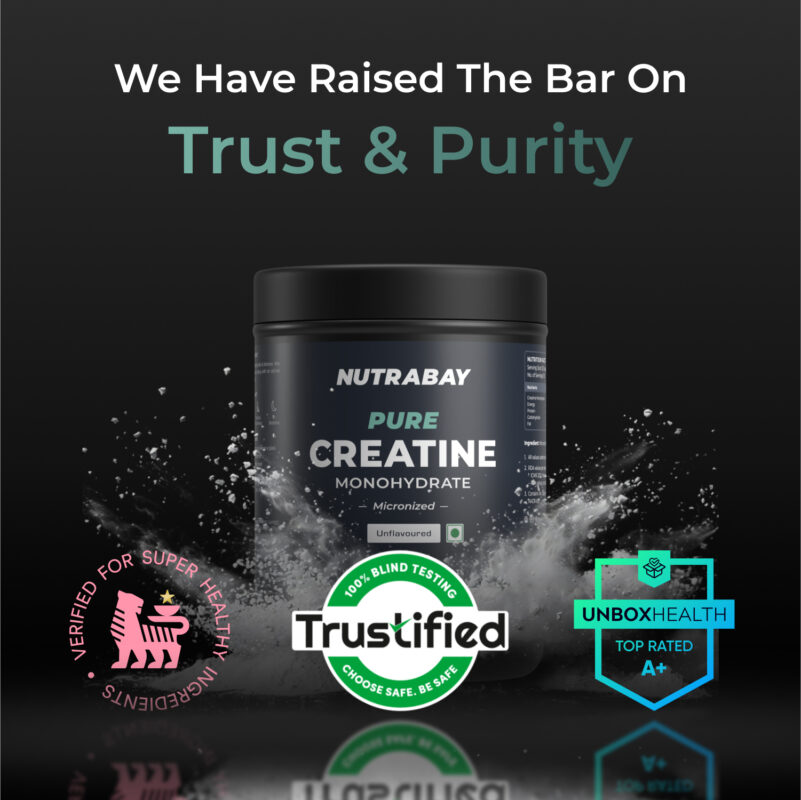
Simplicity prevails when it comes to the best one, and NUTRABAY Pure Creatine Monohydrate meets all the criteria, as it is unflavoured, is a single-ingredient product that uses micronized form, which is easy to dissolve and absorb as well.
Creatine for Men and Women
Both men and women benefit equally from it. Women frequently worry about bulking & gaining weight.
In reality, ladies benefit from it, as it helps
- Boost your strength
- Encourage lean muscle
- Improve the recuperation from training
Muscle hydration, and not fat, is typically the cause of any slight increase on the scale.
Busting Some Common Myths
“Creatine causes dehydration”
No. It actually improves intracellular hydration when water intake is adequate.
“Creatine damages kidneys”
This is actually false for healthy individuals when taken at recommended doses.
“You need to cycle creatine”
No cycling required, continuous use is safe. Though one can give a break for some days and then start again.
Final Thoughts
Is Creatine Worth It for Everyday Athletes?
If you want to:
- Improve your training
- Feel more powerful
- Recuperate more quickly
- Remain constant.
In such a case, creatine makes sense. It is not magical. It won’t take the place of work, rest, or diet. However, creatine fulfills its promise as a supportive aid without causing needless problems.
That dependability is what really counts for regular athletes attempting to strike a balance between daily life and exercise.
Frequently Asked Questions
Is it safe to consume it on a daily basis?
It is safe for healthy people to take it on a regular basis at the suggested dosages.
When is the ideal time to take it?
As long as you take it regularly, any time works.
Can beginners use creatine?
Of course. Even those who are just beginning strength training can benefit from creatine.
Does it lead to weight gain?
No, rather than promoting fat storage, creatine helps muscles stay hydrated.
Is monohydrate superior to other forms?
Indeed, the most studied and efficient type is monohydrate form.
- Kraemer, W. J., & Volek, J. S. (1999). CREATINE SUPPLEMENTATION.Clinics in Sports Medicine,18(3), 651–666. https://doi.org/10.1016/s0278-5919(05)70174-5[↩]
- Effects of creatine supplementation and resistance training on muscle strength and weightlifting performance. (2003).PubMed. https://doi.org/10.1519/1533-4287(2003)017[↩]
- Kreider, R. B., Kalman, D. S., Antonio, J., Ziegenfuss, T. N., Wildman, R., Collins, R., Candow, D. G., Kleiner, S. M., Almada, A. L., & Lopez, H. L. (2017). International Society of Sports Nutrition position stand: safety and efficacy of creatine supplementation in exercise, sport, and medicine.Journal of the International Society of Sports Nutrition,14(1), 18. https://doi.org/10.1186/s12970-017-0173-z[↩]